


The U.S. market research industry is large and competitive.
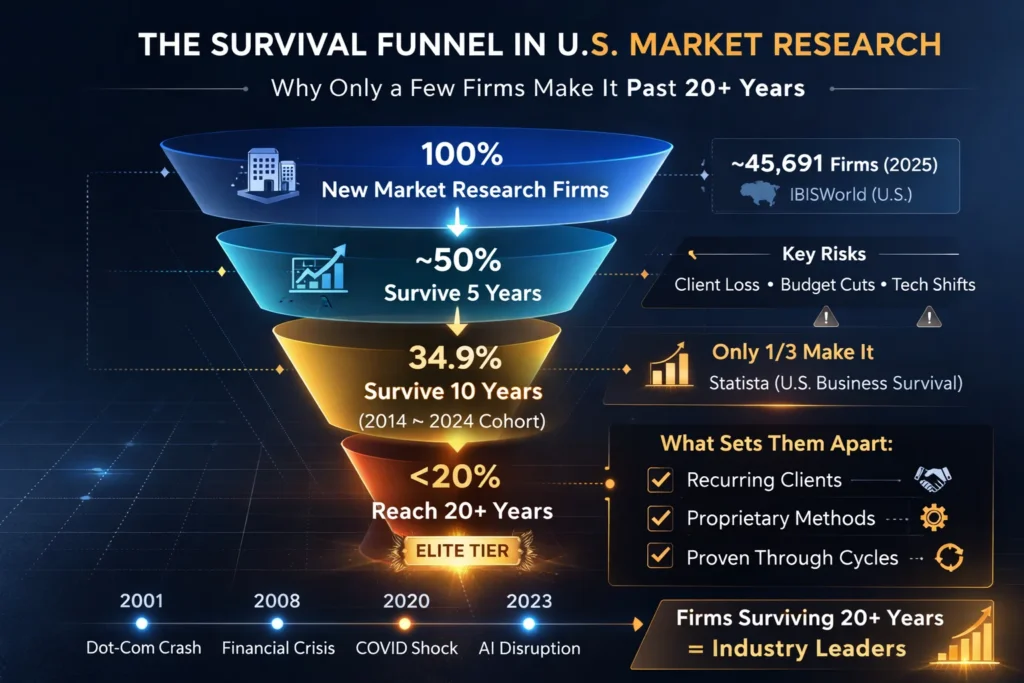
According to IBISWorld, there were 45,691 market research businesses in the United States in 2025.
The same report estimates the industry market size at $36.4 billion in 2026, growing at a 3.8% CAGR over the past five years.
At first glance, this looks like a healthy and expanding sector.
But size does not equal durability.
As per the statista, only 34.9% of U.S. businesses founded between March 2014 and March 2024 were still operating after 10 years.
That means nearly two-thirds of businesses do not make it past their first decade.
Market research firms face the same pressures as other professional services businesses, plus several industry-specific risks:
- Heavy client budget dependency
- Rapid technology disruption
- Methodological shifts
- Panel quality challenges
- Data privacy regulations
- Increasing competition from consultancies and SaaS analytics platforms
So when a firm survives 20, 30, or even 50 years, that is not normal.
It is strategic.
Why Longevity Is Rare in Market Research
Market research is uniquely exposed to change.
Unlike accounting or compliance services, research methods evolve constantly.
1. Technology Disrupts the Core Product
Over the past two decades, the industry has shifted:
- From in-person focus groups to online communities
- From Computer-Assisted Telephone Interviewing (CATI) to mobile-first surveys
- From manual coding to AI-powered text analytics
- From static reports to dashboard-based decision tools
IBISWorld notes that technological change and outsourcing trends have materially reshaped the U.S. market research landscape.
Firms that rely on one old way of doing things often have trouble when that way becomes common and easy for everyone to copy.
2. Client Budgets Rise and Fall Over Time
Market research spending is closely tied to:
- Corporate R&D budgets
- Advertising spending
- Consumer product launches
- M&A activity
During recessions, research is often paused, reduced, or moved in-house.
A firm that lasts more than 20 years has likely gone through:
- The 2001 dot-com downturn
- The 2008 financial crisis
- The COVID-19 disruption
- Post-pandemic restructuring cycles
Surviving the full span of economic and budget cycles, including growth, contraction, recovery, and reinvestment.
3. Competition Is Increasing
The U.S. market research industry has low market share concentration, with major players like IQVIA, Ipsos, and Nielsen holding meaningful share but thousands of small firms competing regionally.
This drives pricing pressure, so smaller firms need to stand out in ways beyond just running surveys.
What Actually Differentiates Long-Lasting Market Research Firms?
Long-lasting market research firms tend to get a few important things right. These habits help them stay relevant even as methods, tools, and technologies change.
1. Repeat Engagements Instead of One-Off Projects
Short-lived firms often survive on one-time research projects. They run a study, deliver the report, and move on.
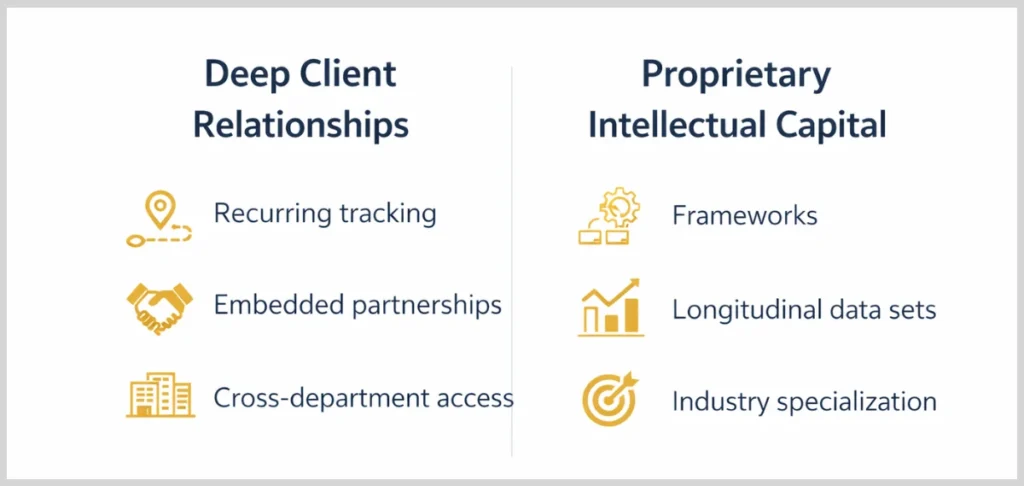
Long-lasting firms build deeper relationships with their clients. Over time, they become trusted research partners rather than just vendors.
They often act as:
- The ongoing insights partner
- The preferred vendor for annual tracking studies
- The go-to team for product testing cycles
- A strategic advisor for marketing or product teams
According to a survey of market research professionals, 65% measure success by the number of actions taken based on their insights, not simply by delivering reports.
That difference matters.
When research helps shape real business decisions, clients rely on that firm again and again. But when a firm only produces reports, it becomes easier to replace.
2. Building Relationships Across Multiple Teams
Market research budgets often move up and down depending on business conditions. When companies reduce spending, they usually cut vendors that feel optional.
Long-lasting firms avoid this risk by building relationships across multiple teams inside the organization.
Instead of working with just one contact in the marketing department, they often collaborate with:
- Product teams
- Customer experience leaders
- Strategy departments
- Innovation or R&D teams
They may manage recurring tracking studies, help test new products, or support customer experience programs.
Because their work supports several business areas, their role becomes harder to remove during budget cuts.
3. Owning Proprietary Methods and Knowledge
Technology in market research keeps evolving. New survey platforms appear, analytics tools improve, and data collection methods continue to change.
However, the real advantage for long-lasting firms comes from the knowledge and frameworks they develop over time.
These firms often build assets such as:
- Proprietary research frameworks
- Industry specialization (healthcare, automotive, B2B, CPG)
- Unique research panels or communities
- Longitudinal datasets collected over many years
- Signature methodologies that clients recognize
Several well-known firms show this pattern:
- Nielsen Holdings (founded 1923)
- Ipsos (founded 1975)
- Gartner (founded 1979)
- Qualtrics (founded 2002)
These companies lasted because they developed defensible research models and valuable data assets.
They continued adapting their tools and technology while protecting the core knowledge that made their insights valuable.
The Role of Specialization in Market Research
The U.S. market research industry covers:
- Quantitative research
- Qualitative research
- Focus groups
- Statistical analysis
- Public opinion polling
But simply offering these services does not create an advantage.
Durable market research firms usually focus deeply on a specific area instead of trying to do everything. Over time, they build a strong reputation in one or two industries or research specialties.
This allows them to develop proprietary benchmarks, deeper datasets, and insights that generalist firms often cannot match. As their expertise grows, they become known for a particular capability or type of research, which helps them stand out in a crowded market.
Why Buyers Value 20+ Year Market Research Firms
For buyers, longevity reduces uncertainty. Here is why.
1. Predictable Revenue Patterns
Recurring tracking studies, syndicated data, and long-term retainers help stabilize revenue.
Firms with recurring income are valued higher than those relying only on one-off projects.
2. Institutional Knowledge
In many younger firms, knowledge lives in the founder.
In durable firms, knowledge lives in:
- Senior analysts
- Methodology documentation
- Training systems
This makes the ownership transition smoother.
3. Brand Equity
After 20+ years, a firm’s brand carries weight:
- Conference visibility
- Industry awards
- Published thought leadership
- Word-of-mouth referrals
That lowers the marketing spend required for growth, where having a strong reputation and referrals bring new clients naturally. This means organizations do not need to spend much on advertising and marketing to attract new business.
The AI Factor: A New Longevity Test
Recent industry reporting shows AI adoption is reshaping the industry.
AI integration has become “non-negotiable,” with firms using AI tools for analytics and automation.
Long-lasting firms are not those that resist technology. They are those who integrate it without losing methodological rigor.
They combine:
- Human expertise
- Domain specialization
- AI-enabled speed
- Data governance discipline
The next generation of long-lasting firms will be built on this hybrid approach.
Built Different: Market Research Firms That Last Forever
Longevity in market research rarely happens by chance. Firms reaching 20 years or more are built with real discipline. They create steady client relationships that last, develop clear proprietary methods, and build systems that run smoothly beyond any one founder.
These same qualities draw buyers who think long-term. They want strength over flash. Stability over risky bets. Durable market research firms fit perfectly with patient investors. Businesses are designed to endure for decades, not just shine for a few strong years.
Ready For Your Next Chapter?
AA24 Holdings buys well-run, long-lasting market research firms. We target businesses with strong foundations. Proven leadership. Clean operations.
Let’s talk. adi@aa24holdings.com